


 Improving Safety, Accuracy and Efficiency During Installation
In the ever-evolving landscape of renewable energy, wind power stands as a cornerstone of sustainable solutions to our energy needs. The installation of wind turbine components, particularly blades, has been a persistent challenge due to the delicate nature of these components and the unpredictability of wind conditions. Recognising these challenges, Huisman has developed two solutions: the Wind Gust Buster and the Travelling Load Stabilising System. These innovations offer a comprehensive approach to ensuring safer, more precise, and efficient wind turbine component installations.
By Annet Stuurman, Manager PR & Communications, Huisman, the Netherlands
As wind energy gains global prominence, the complex installation of wind turbine components remains a challenge. Huisman has recently introduced two innovations to enhance safety, reduce downtime and fortify wind turbine component integrity.
 Wind Gust Buster: Anticipating Wind for Safety
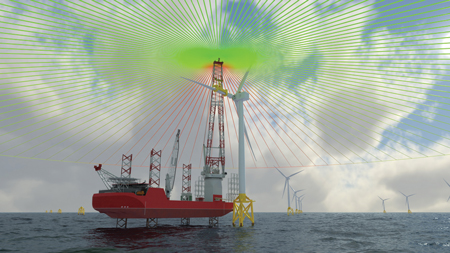
The Wind Gust Buster is a system that empowers crane operators and lifting supervisors to anticipate and react to approaching increases in wind speed, incoming gusts and direction changes during the installation process of turbine blades. By providing information on the incoming wind around the crane’s boom tip, this system enhances safety and control during wind turbine component installations.
Unsafe Situations
Turbine blades are very sensitive to wind and can easily be damaged during the operation if the potential for sudden change is not taken into account. Traditionally, the wind speed and direction are only measured at the location of the vessel. This does not provide the crane operator with the opportunity to factor in changes that may take place in the short term, which can result in unsafe situations and/or damage. Additionally, wind sensor locations on the vessel can be influenced by surrounding structures such as jack-up legs, wind turbine parts or other objects. This makes a reliable wind speed measurement more challenging, with a risk of unnecessary downtime.
Turbine blades are very sensitive to wind and can easily be damaged during the operation if the potential for sudden change is not taken into account. Traditionally, the wind speed and direction are only measured at the location of the vessel. This does not provide the crane operator with the opportunity to factor in changes that may take place in the short term, which can result in unsafe situations and/or damage. Additionally, wind sensor locations on the vessel can be influenced by surrounding structures such as jack-up legs, wind turbine parts or other objects. This makes a reliable wind speed measurement more challenging, with a risk of unnecessary downtime.
‘Go or No-Go’ Decision
Measurement of the incoming wind is done by application of a lidar system on the crane’s boom tip, scanning the horizontal area. The measurement data is post-processed by the crane’s automation system and can be shown to both the crane operator as well as to other people involved, such as on the crane vessel’s bridge. A typical prediction window is 5 to 8 minutes ahead of the wind gust coming in, which allows sufficient time to make the ‘go or no-go’ decision for mating a blade to a nacelle.
Measurement of the incoming wind is done by application of a lidar system on the crane’s boom tip, scanning the horizontal area. The measurement data is post-processed by the crane’s automation system and can be shown to both the crane operator as well as to other people involved, such as on the crane vessel’s bridge. A typical prediction window is 5 to 8 minutes ahead of the wind gust coming in, which allows sufficient time to make the ‘go or no-go’ decision for mating a blade to a nacelle.
Wind Lidar
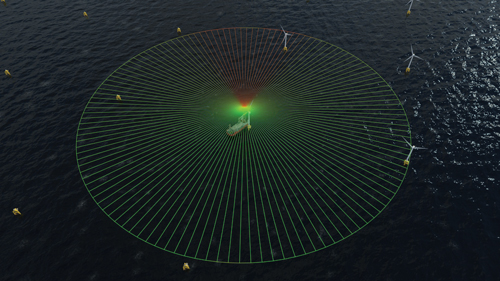
The lidar sensor measures the wind speed at multiple distances from the vessel, up to several kilometres ahead. This is achieved by emitting and retrieving laser pulses backscattered by micro particles in the atmosphere. The lidar sensor is capable of scanning all around in elevation and azimuth, thus allowing real-time mapping of the incoming wind field through direct measurements. This allows observation of wind speed and direction ahead, and sudden changes in the wind speed during the following few minutes can be predicted. As an example, a wind observed with an average speed of 15m/s at a distance of 7,200 metres will arrive at the wind turbine within approximately 8 minutes. As the wind speed is measured over several distances simultaneously, the wind ramp and its duration can also be seen, allowing the operator to select the proper installation period.
The lidar sensor measures the wind speed at multiple distances from the vessel, up to several kilometres ahead. This is achieved by emitting and retrieving laser pulses backscattered by micro particles in the atmosphere. The lidar sensor is capable of scanning all around in elevation and azimuth, thus allowing real-time mapping of the incoming wind field through direct measurements. This allows observation of wind speed and direction ahead, and sudden changes in the wind speed during the following few minutes can be predicted. As an example, a wind observed with an average speed of 15m/s at a distance of 7,200 metres will arrive at the wind turbine within approximately 8 minutes. As the wind speed is measured over several distances simultaneously, the wind ramp and its duration can also be seen, allowing the operator to select the proper installation period.
Unobstructed View
The lidar is placed on the boom tip, allowing a 360-degree view in the horizontal plane without any obstruction by deck load, such as large towers. The 360-degree view allows the sensor to always be orientated in the direction of the wind, independent of the boom orientation. The sensor is always level with the horizon to scan the wind in the horizontal plane. The wind data is also available to other systems like the DP system.
The lidar is placed on the boom tip, allowing a 360-degree view in the horizontal plane without any obstruction by deck load, such as large towers. The 360-degree view allows the sensor to always be orientated in the direction of the wind, independent of the boom orientation. The sensor is always level with the horizon to scan the wind in the horizontal plane. The wind data is also available to other systems like the DP system.
Features of the Wind Gust Buster
- Measurement of approaching wind speed and direction over a distance of up to 10 kilometres.
- Sudden changes in wind speed are detected in advance, allowing crew members, such as the person guiding the blade into the nacelle, to be informed.
- Unobstructed measurement of the wind speed as the sensor is placed on the top of the boom, avoiding unnecessary downtime caused by inaccurate wind speed measurement due to sensor blockage.
The development of this system contributes to Huisman’s ambition to improve the installation of offshore wind turbines. Another recently introduced solution for the controlled installation of blades is the Travelling Load Stabilising System.
 Travelling Load Stabilising System: Precision in Installation
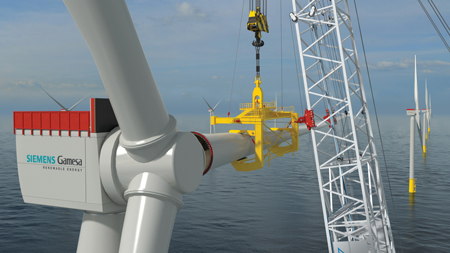
Huisman and Siemens Gamesa, a prominent wind turbine manufacturer, have collaboratively developed the Travelling Load Stabilising System, offering a comprehensive solution to control the movement of wind turbine components. This system reduces operational downtime and increases the integrity of these delicate components, such as blades, nacelles, and tower segments.
Working in Unison for Maximum Control
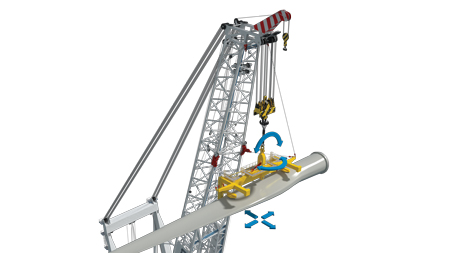
The Travelling Load Stabilising System employs two pairs of tugger winches that work in unison to control the position of the load. These winches, situated on the crane’s boom, ensure optimal tugger line configuration by approaching the load from two different directions. The system’s specially designed control system maintains the load’s position, providing a much stiffer restraint and therefore higher position accuracy compared with conventional tugger systems relying on constant tension. In case of an unexpected overload, the system will give way but will return to its position setpoint when the force drops below the threshold again.
The Travelling Load Stabilising System employs two pairs of tugger winches that work in unison to control the position of the load. These winches, situated on the crane’s boom, ensure optimal tugger line configuration by approaching the load from two different directions. The system’s specially designed control system maintains the load’s position, providing a much stiffer restraint and therefore higher position accuracy compared with conventional tugger systems relying on constant tension. In case of an unexpected overload, the system will give way but will return to its position setpoint when the force drops below the threshold again.
Features of the Travelling Load Stabilising System
- Effective load control because tugger winches are always at the optimal elevation.
- Boom trolleys have a much higher stiffness compared with flexible tag lines, increasing control.
- Winches operate with position control, which is much stiffer compared with constant tension mode.
- Operation of the tugger system is fully integrated with the crane’s control system.
- Suitable for lifting operations.
- Time-consuming boom luffing is not required.
- Suitable for man riding.
- On request, the tugger system can be automated for specific tasks with all other crane parameters as input.
- Huisman’s latest crane designs have provisions allowing a retrofit of the Travelling Load Stabilising System.
 The Future of Wind Turbine Installation
The introduction of these innovative solutions marks a significant step towards the efficient and safe installation of wind turbine components. Jesper Moeller, Chief Engineer Execution at Siemens Gamesa, highlights the impact of the Travelling Load Stabilising System on next-generation offshore wind turbine installations, particularly under challenging wind conditions. This technology promises increased installation uptime, improved on-site safety and potential benefits for the entire wind industry.
Collaboration for Progress
David Roodenburg, CEO of Huisman, emphasises the importance of collaboration and innovation in driving the energy transition. By merging Siemens Gamesa’s operational expertise with Huisman’s technical equipment knowledge, these solutions offer efficient ways to reduce weather-related downtime in wind turbine installations, thus accelerating the transition to cleaner energy sources.
David Roodenburg, CEO of Huisman, emphasises the importance of collaboration and innovation in driving the energy transition. By merging Siemens Gamesa’s operational expertise with Huisman’s technical equipment knowledge, these solutions offer efficient ways to reduce weather-related downtime in wind turbine installations, thus accelerating the transition to cleaner energy sources.
The wind energy sector continues its remarkable growth, with innovations like the Wind Gust Buster and the Travelling Load Stabilising System playing an important role in achieving higher efficiency, safety and precision in wind turbine component installation. As the world’s demand for sustainable energy sources grows, these advancements contribute to a greener and more sustainable future.