

Everybody Expects It – But Are They Right?
Consolidation within the wind sector has been much discussed over the past 12–18 months due to weakening demand and ongoing price pressure. However, with global demand down and a manufacturing overcapacity already existing, the consolidation of Tier 2/3 wind OEMs into Tier 1 global competitors is not likely unless there are other factors at play. These other factors include leveraging an intellectual property portfolio, gaining strategic access to a market, gaining a manufacturing footprint in an underserved market, or providing some level of vertical integration. In this article, Philip Totaro considers the wind turbine market and OEM outlook for the next 12–18 months, both globally and for different regions of the world.
By Philip Totaro, Principal, IntelStor, USA
{access view=!registered}Only logged in users can view the full text of the article.{/access}{access view=registered}Over the next 12–18 months it is likely that the order books of Tier 1 wind OEMs will continue to remain relatively full, but they may or may not seek strategic acquisitions to increase that manufacturing capacity. However, global demand is expected to turn around in the coming years, so in anticipation of future demand there may be some need to add manufacturing footprint in strategic markets.
Unfortunately, with margins already being squeezed to the limit, cash may be hard to come by for acquisitions. A number of companies have already expressed interest in seeking joint ventures (JVs), which may be a better option than using all available cash on hand or leveraging what financing may be available.
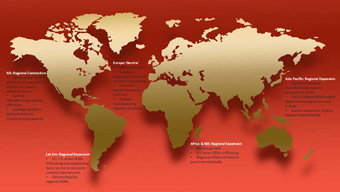
Asia Pacific
Within China it has generally been expected that consolidation will occur. Formerly cash-rich Tier 1 Chinese companies, which were looking at acquisitions both domestically as well as throughout Europe, are now struggling with profitability. This obviously reduces their willingness to spend on acquisitions.
Additionally, with ~30–40GW of annual manufacturing capacity and only about 15GW in domestic annual capacity additions projected for the next five years, there will have to be a removal of over-capacity from the market in order to stabilise prices. The only alternative, if that manufacturing capacity is to be retained, is for the Chinese OEMs to branch out globally.
While some Chinese companies may be interested in branching out into Europe, Latin America and Africa, few will be able to do so in a sustainable manner. In the past three months, both Goldwind and Sinovel have raised substantial funds from development banks and other lenders in order to grow their international footprint. Quality and availability still remain the issues that have to be addressed before Chinese companies can compete globally.
Europe
Within Europe there are a number of regional Tier 2/3 wind OEMs that are struggling to figure out their next move. Without scale they have found it difficult to continue to compete within their core markets, which have now been invaded by Tier 1s looking to grow their international footprint and supplant expected orders in markets where demand is eroding. Tier 1s are now actively competing for projects in countries like Turkey, Poland and Romania. There are still select underserved markets with demand for both onshore and offshore capacity (e.g. Malta), but total capacity may be small.
Where does that leave the Tier 2/3 OEMs? It simply does not make sense to acquire a competitor if demand is not robust enough to support the breadth of the combined company. This may lead to failures unless some type of JV or other arrangement can be made to sustain the operation until robust demand returns.
North America
Even in the USA there is now about 11–13GW of annual manufacturing capacity on-line, with more in the pipeline looking back to the projections of 2009/10. With the production tax credit (PTC) uncertainty and likelihood that it will not be addressed until after the Presidential election, this leaves substantial excess capacity with ever weakening demand.
There are a number of factories in the USA with orders, but order books among the Tier 2/3s seem likely to be too small to sustain a full complement of staff. Tier 1 order books are largely full, but as with other regions the Tier 2/3 OEMs continue to limp along with modest sales in the hope that demand returns in a robust way. If they cannot garner enough sales to break even we may see large-scale layoffs, and even closures, of domestic factories before the close of 2012.
Canada continues to expect some growth in its markets, and with the PTC threatening to expire in the USA without extension, many OEMs with manufacturing capacity in North America are looking to Canada and Mexico for new orders.
Latin America
Expansion here is likely to continue with Brazil, Uruguay, Peru, Chile and Argentina leading the way. Many Tier 1/2 turbine OEMs have already established factories here based on initial orders and are hoping to continue the growth.
While demand continues and wind is relatively cost-competitive in Latin America, whether or not a turbine OEM can maintain profitability will have a large impact on its ability to support a global footprint.
Conclusion
Overall, what can be expected in the wind industry in the next two years is for regional Tier 2/3 wind OEMs to join forces in the hopes of forming a Tier 1/2 in which the sum is more globally competitive than the regional parts.
We expect Korean turbine OEMs to seek merger and acquisition deals with European and Latin American companies. They have had less exposure to the boom and bust of the Chinese market and several have the backing of large industrial conglomerates that expect to grow the revenue of their wind business.
Within China we are likely to see Goldwind, Sinovel, Guodian United Power, Dongfang and Mingyang sustain themselves, while the majority of the rest fade away or get folded into these top five. Overall, we expect the 50–70 or so OEMs remaining in this market to be reduced down to 12–15.
In certain markets manufacturing capacity simply exceeds demand, so layoffs as well as divestments of manufacturing assets can be expected. Consolidation further down in the supply chain is also possible as some companies may look to divest the portion of their business related to wind.
Failure of certain struggling wind companies or component suppliers is also not out of the question. As mentioned before, unless they have an intellectual property portfolio worth acquiring, or they offer other strategic value, then they are likely to simply fail under their own weight.
While everyone expects consolidation to happen, the complexity of the global demand picture and the overall excess in manufacturing capacity makes it difficult to expect the industry to just continue to limp along. The good news is the truly competitive technologies and companies behind them will rise to the top and emerge from this period stronger, more globally diverse, likely more vertically integrated, and able to fulfil the promise of cost-competitive clean energy.
Biography of the Author
Mr Philip Totaro is the Principal at IntelStor, a consulting firm focused on innovation strategy, market research and competitive intelligence, product development and patent search for the wind industry.{/access}
Consolidation within the wind sector has been much discussed over the past 12–18 months due to weakening demand and ongoing price pressure. However, with global demand down and a manufacturing overcapacity already existing, the consolidation of Tier 2/3 wind OEMs into Tier 1 global competitors is not likely unless there are other factors at play. These other factors include leveraging an intellectual property portfolio, gaining strategic access to a market, gaining a manufacturing footprint in an underserved market, or providing some level of vertical integration. In this article, Philip Totaro considers the wind turbine market and OEM outlook for the next 12–18 months, both globally and for different regions of the world.By Philip Totaro, Principal, IntelStor, USA
{access view=!registered}Only logged in users can view the full text of the article.{/access}{access view=registered}Over the next 12–18 months it is likely that the order books of Tier 1 wind OEMs will continue to remain relatively full, but they may or may not seek strategic acquisitions to increase that manufacturing capacity. However, global demand is expected to turn around in the coming years, so in anticipation of future demand there may be some need to add manufacturing footprint in strategic markets.
Unfortunately, with margins already being squeezed to the limit, cash may be hard to come by for acquisitions. A number of companies have already expressed interest in seeking joint ventures (JVs), which may be a better option than using all available cash on hand or leveraging what financing may be available.
Asia Pacific
Within China it has generally been expected that consolidation will occur. Formerly cash-rich Tier 1 Chinese companies, which were looking at acquisitions both domestically as well as throughout Europe, are now struggling with profitability. This obviously reduces their willingness to spend on acquisitions.
Additionally, with ~30–40GW of annual manufacturing capacity and only about 15GW in domestic annual capacity additions projected for the next five years, there will have to be a removal of over-capacity from the market in order to stabilise prices. The only alternative, if that manufacturing capacity is to be retained, is for the Chinese OEMs to branch out globally.
While some Chinese companies may be interested in branching out into Europe, Latin America and Africa, few will be able to do so in a sustainable manner. In the past three months, both Goldwind and Sinovel have raised substantial funds from development banks and other lenders in order to grow their international footprint. Quality and availability still remain the issues that have to be addressed before Chinese companies can compete globally.
Europe
Within Europe there are a number of regional Tier 2/3 wind OEMs that are struggling to figure out their next move. Without scale they have found it difficult to continue to compete within their core markets, which have now been invaded by Tier 1s looking to grow their international footprint and supplant expected orders in markets where demand is eroding. Tier 1s are now actively competing for projects in countries like Turkey, Poland and Romania. There are still select underserved markets with demand for both onshore and offshore capacity (e.g. Malta), but total capacity may be small.
Where does that leave the Tier 2/3 OEMs? It simply does not make sense to acquire a competitor if demand is not robust enough to support the breadth of the combined company. This may lead to failures unless some type of JV or other arrangement can be made to sustain the operation until robust demand returns.
North America
Even in the USA there is now about 11–13GW of annual manufacturing capacity on-line, with more in the pipeline looking back to the projections of 2009/10. With the production tax credit (PTC) uncertainty and likelihood that it will not be addressed until after the Presidential election, this leaves substantial excess capacity with ever weakening demand.
There are a number of factories in the USA with orders, but order books among the Tier 2/3s seem likely to be too small to sustain a full complement of staff. Tier 1 order books are largely full, but as with other regions the Tier 2/3 OEMs continue to limp along with modest sales in the hope that demand returns in a robust way. If they cannot garner enough sales to break even we may see large-scale layoffs, and even closures, of domestic factories before the close of 2012.
Canada continues to expect some growth in its markets, and with the PTC threatening to expire in the USA without extension, many OEMs with manufacturing capacity in North America are looking to Canada and Mexico for new orders.
Latin America
Expansion here is likely to continue with Brazil, Uruguay, Peru, Chile and Argentina leading the way. Many Tier 1/2 turbine OEMs have already established factories here based on initial orders and are hoping to continue the growth.
While demand continues and wind is relatively cost-competitive in Latin America, whether or not a turbine OEM can maintain profitability will have a large impact on its ability to support a global footprint.
Conclusion
Overall, what can be expected in the wind industry in the next two years is for regional Tier 2/3 wind OEMs to join forces in the hopes of forming a Tier 1/2 in which the sum is more globally competitive than the regional parts.
We expect Korean turbine OEMs to seek merger and acquisition deals with European and Latin American companies. They have had less exposure to the boom and bust of the Chinese market and several have the backing of large industrial conglomerates that expect to grow the revenue of their wind business.
Within China we are likely to see Goldwind, Sinovel, Guodian United Power, Dongfang and Mingyang sustain themselves, while the majority of the rest fade away or get folded into these top five. Overall, we expect the 50–70 or so OEMs remaining in this market to be reduced down to 12–15.
In certain markets manufacturing capacity simply exceeds demand, so layoffs as well as divestments of manufacturing assets can be expected. Consolidation further down in the supply chain is also possible as some companies may look to divest the portion of their business related to wind.
Failure of certain struggling wind companies or component suppliers is also not out of the question. As mentioned before, unless they have an intellectual property portfolio worth acquiring, or they offer other strategic value, then they are likely to simply fail under their own weight.
While everyone expects consolidation to happen, the complexity of the global demand picture and the overall excess in manufacturing capacity makes it difficult to expect the industry to just continue to limp along. The good news is the truly competitive technologies and companies behind them will rise to the top and emerge from this period stronger, more globally diverse, likely more vertically integrated, and able to fulfil the promise of cost-competitive clean energy.
Biography of the Author
Mr Philip Totaro is the Principal at IntelStor, a consulting firm focused on innovation strategy, market research and competitive intelligence, product development and patent search for the wind industry.{/access}