



 A Step Towards Mitigating Wind Turbine Annoyance
‘What is their problem, really?’ This question has been voiced by developers and operators of wind power, as it relates to citizens who complain of annoyance from wind turbines. ‘After all, most people are not annoyed, and they recognise how important development of wind resources is to combat climate change,’ we hear. Sometimes, the statement is more forceful: ‘most normal people are not annoyed,’ implying somewhat harshly that there may be something abnormal with those annoyed. When one makes a conscientious effort to communicate with people expressing annoyance, one finds they are neither malcontents nor oblivious to climate change concerns. Yet, one hears them express words such as, ‘I just haven’t been able to stand it in my home since the wind turbines were installed.’ For those impacted, annoyance is not merely a temporary unpleasant phenomenon but a condition that adversely impacts their life and health.
By William K.G. Palmer, Independent Researcher, Canada
To assess annoyance, the customary technique is to assemble a random panel of assessors to stay in the environment of the one annoyed for a period of time. But that method is not practical for a condition that is neither continuous nor even fully predictable. The goal of this work was to develop an objective method based on measures of physical parameters that could replace a subjective assessment of when annoyance exists.
It is well established in the scientific literature that amplitude modulation (or AM), a measure of the variation of the broadband intensity of the sound received from a wind turbine, can be linked to annoyance. This is often considered a method of assessing the depth of the signature ‘swoosh’ as the wind turbine blades rotate. Although there are techniques to assess the amplitude of AM, such as the procedure of the Institute of Acoustics in the UK, the assessment is neither simple nor quick. A simplified method of assessing the variation of the sound received is to calculate the difference between the L10 and L90 sound levels. While this is not an actual assessment of the depth of the AM, it does provide an alternate comparison of the variation. L90, the minimum sound level present over 90% of the time is often considered an assessment of the background noise. Similarly, L10 is an assessment of a higher sound level present less than 10% of the time. Thus, L10−L90 can be considered an assessment of the variation in the sound level.
Calibrated microphones were installed to monitor and enable the recording of sound levels present outside a residence where the occupants had filed complaints of annoyance from wind turbines. During a 195-day monitoring period, the occupants logged 29 representative examples of when the conditions were considered moderately (7/10) to highly (9/10) annoying. They did not log every occasion of annoyance. Even if conditions persisted for some days, the occupants would only log an example every three or four days. At the end of the monitoring period, the recording apparatus was removed to analyse the recordings made on the days when annoyance was recorded. It was found that data was only available for 81 of the 195 days of the monitoring period due to losses of recording arising from power failures. Analysis was done for 1-minute samples for each period considered moderately to highly annoying, for which data was available, assessing both LA10−LA90 and LZ10−LZ90. The results of the analysis are shown in Table 1.
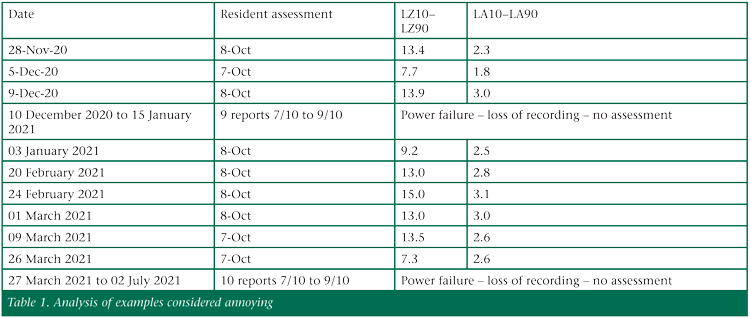
A change of 3dBA is typically considered to be the minimum for most people to perceive that a change in sound amplitude has occurred. The measure of sound by Z-weighting does not suppress higher and lower frequencies that may be less easily perceived. A change of greater than 6 dBZ might be required for many people to recognize that a Z-weighted change in sound amplitude had occurred. These considerations, and a review of the results in Table 1, suggest that a criterion for annoyance might be when LA10−LA90 ≤ 3dBA, and LZ10−LZ90 ≥ 6dBZ.
Analysis of 25 additional recordings from other locations with different turbine types showed that also in those situations the criterion was met when annoyance by different observers was recorded.
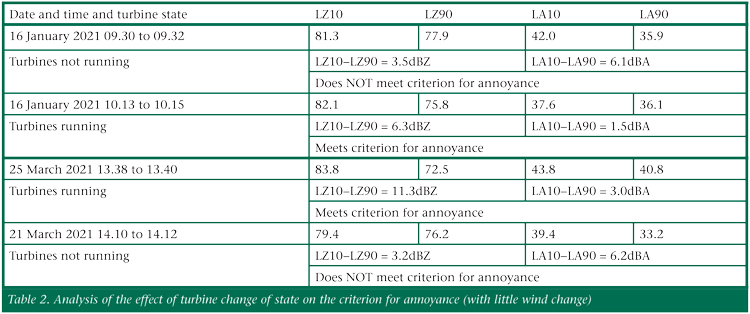
The criterion was tested next to determine whether it was only met as a result of wind on the microphones, or the surroundings. Analysis was conducted of the acoustic conditions during wind turbine change of state, as the wind conditions change little in the few minutes of the transition. The results of the analysis in Table 2 show that the criterion was met when turbines were operating but not when turbines were shut down.
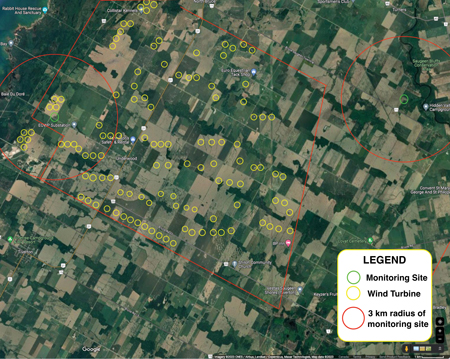
A further test was carried out to ensure that it was the proximity of turbines and not the wind that resulted in the criterion being met. Simultaneous acoustic monitoring was conducted at a site about 537 metres from the nearest wind turbine and at a second site > 6 kilometres from the nearest wind turbine. Figure 1 shows that the locations of the two monitoring sites, which were in similar terrain, had a similar proximity to roadways and very similar environmental conditions.
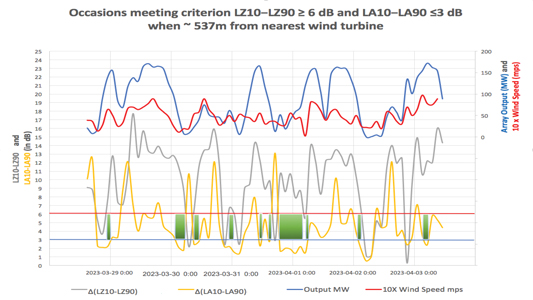
In a 7-day monitoring period, there were no occasions when the criterion was met at the site distant from the wind turbines. However, it was met for varying durations on 6 days of the 7-day period near the wind turbines. Figure 2 shows, by green shaded rectangles, the times when the annoyance criterion was met at the near site. The figure shows that the annoyance criterion was not necessarily met when turbine output or wind speeds were highest. The criterion was met when the Z-weighted turbine sound variation dominated the A-weighted variation. Even though environmental conditions were very similar at both sites, there were no occasions when the annoyance criterion was met due to wind-induced noise at the distant site.
The work shows that annoyance can be reliably predicted by an objective measure based on simple-to-determine acoustic parameters. The objectively predicted annoyance correlates closely with times when impacted residents subjectively identify annoyance. This criterion can be used to assess when annoyance is predicted to occur and thus when mitigatory action should be taken. The important finding shows that annoyance is linked to an acoustic condition present when wind turbines operate and is not only a product of visual triggers or attitude.
Further Reading
- IOA Noise Working Group (Wind Turbine Noise), Amplitude Modulation Working Group. 2016. Final Report, A Method for Rating Amplitude Modulation in Wind Turbine Noise. Institute of Acoustics.
- Palca, J. January 2020. Why do we get annoyed? Science has irritatingly few answers. National Geographic, 19–22.
- Palca, J. and Lichtman, F. 2011. Annoying: The Science of What Bugs Us. New York: John Wiley & Sons.
- Palmer, W.K.G. 2023. Lessons learned monitoring near and further from wind turbines. Canadian Acoustics 51(3), 172–173.
- Peterson, C. July 2011. Things that annoy us. Psychology Today.
- Van Kamp, I. and van den Berg, F. 2021. Health effects related to wind turbine sound: an update. International Journal of Environmental Research and Public Health 18(17), 9133.