


 Technologies, Modelling and Costs
Wind turbines are subject to high mechanical and environmental loads, including extreme winds, storms, rain, gravitational load on rotating blades, and temperature and humidity variations. These loads lead to the degradation of wind turbine parts, in particular wind turbine blades. Repair of wind turbine blades can cost many thousands of dollars. Such high costs can influence the wind energy costs in general. Thus, efficient repair of wind turbines is an important element of the renewable energy transition, making wind energy more competitive. In this article, mechanisms of wind turbine blade degradation, repair technologies and possibilities to reduce the repair costs are reviewed.
By Leon Mishnaevsky Jr, Senior Scientist, Technical University of Denmark, Denmark
Competitiveness of Wind Energy and Repair Technology
The competitiveness of wind energy on the energy market depends on its costs, which are in turn influenced by operation and maintenance expenses. Repair and maintenance costs can reach one fifth of the levelised cost of wind energy.
The competitiveness of wind energy on the energy market depends on its costs, which are in turn influenced by operation and maintenance expenses. Repair and maintenance costs can reach one fifth of the levelised cost of wind energy.
 In contrast to other large moving structures (e.g. aeroplanes or cars), wind turbines are inspected relatively seldomly and are also often located far away from factories and service centres. This makes their repair even more expensive. Another area in which repair technology and cost play an important role is the management of decommissioned, used wind turbine blades. Wind turbine blades, made from highly durable composites, are not easily recycled. Repair for the reuse of wind turbine blades is considered the most mature technology, among other available blade decommissioning scenarios. Therefore, the efficiency of wind turbine blade repair is a critical part of ensuring the competitiveness and sustainability of wind energy. In order to improve the repair quality, good understanding of both wind turbine blade degradation mechanisms and repair technologies is required.
Wind Turbine Blade Damage Mechanisms
Which mechanisms are typically responsible for the damage of wind turbine blades? In several investigations most common degradation mechanisms were studied. Among other mechanisms, erosion of the leading edges of blades, degradation of adhesive joints (in trailing edge, or between the spar and skin of the blades), buckling and collapse of blades are listed as the most common blade repair reasons. Degradation can be caused by the fatigue of materials (in adhesive joints, or coatings), extreme winds (causing buckling of blades) or lightning strikes.
Which mechanisms are typically responsible for the damage of wind turbine blades? In several investigations most common degradation mechanisms were studied. Among other mechanisms, erosion of the leading edges of blades, degradation of adhesive joints (in trailing edge, or between the spar and skin of the blades), buckling and collapse of blades are listed as the most common blade repair reasons. Degradation can be caused by the fatigue of materials (in adhesive joints, or coatings), extreme winds (causing buckling of blades) or lightning strikes.
 While major failures of blades require expensive repairs, they are relatively seldom (once per 10 years, on average). Blade surface erosion is observed quite often and can require repair every 2 to 3 years. The surface erosion of blades can therefore lead to up to 10 times higher maintenance costs than the much more drastic collapse of blades.
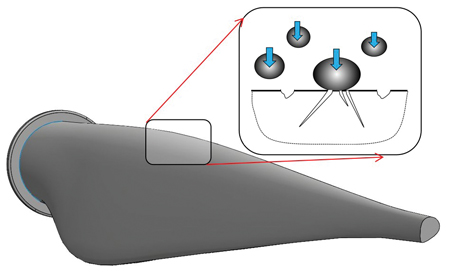
Leading edge erosion of wind turbine blades, which represents the most often observed, and also the most expensive, blade degradation mechanism, is caused by the multiple impact of rain droplets on the blade surface. Figure 1 shows a schema of how the blade surface degrades and a photograph of an eroded blade. A number of computational models of leading edge erosion of wind turbine blades have been developed at the Technical University of Denmark (DTU), which allow prediction of the coating lifetime and analysis of the effect of the coating properties on the lifetime. Internal manufacturing defects in the coatings (e.g. voids) are among the critical factors triggering blade surface degradation. The surface erosion can lead to cracking in the blade laminates if not repaired early enough.
Repair Technologies
After damage of a wind turbine blade is registered, the blade has to be repaired. Knowing the most likely blade damage mechanism, the blade service team can design an appropriate repair approach. Normally, the repair is carried out by removal of the damaged region and filling, attaching and bonding the repair scarf to the blade.
After damage of a wind turbine blade is registered, the blade has to be repaired. Knowing the most likely blade damage mechanism, the blade service team can design an appropriate repair approach. Normally, the repair is carried out by removal of the damaged region and filling, attaching and bonding the repair scarf to the blade.
What are the criteria for selecting the appropriate repair technology? The criteria include the quality of the repair (characterised, for instance, by post-repair strength and lifetime) and the costs. Given the relatively high costs of service technician work, and also the quite narrow weather window for on-site blade repair, quick repair and bonding are preferred to long repair (assuming that it can ensure the same quality). For instance, repair with the use of ultraviolet (UV) curing technology, , allows a reduction in the repair time from several hours (for thermal curing) to 20 to 30 minutes, thus drastically reducing the costs.
 |
 |
The repaired plates were tested (tensile static and fatigue), and microscopic X-ray investigation of the structure of the repaired samples was carried out. Generally, all the tested technologies ensured good strength of the repaired blades (otherwise, it is assumed, they would not survive on the market). Still, a blade can contain some microscale defects, voids and residual stresses in the repaired region. These defects can drastically reduce the post-repair lifetime of the blades. Also, in some cases, cracks in the ‘parent’ composite and microcracks in the scarf can be observed after repair. Figure 3 shows a schema of a computational model of a repaired blade with microscale voids, and also micrographs of voids in repaired blades, obtained using X-ray microscopy. The porosity of repaired structures is minimal under vacuum repair with infusion, quite large for vacuum repair with hand lay-up, and average for repair with UV curing. The porosity and residual stresses in the repaired structures can be reduced by the optimal choice of curing regimes, for instance by multistep variation of curing temperatures.
Conclusions
Optimisation of repair technologies of wind turbine blades is critically important for the reduction of wind energy costs and ensuring the sustainability of wind turbines. Understanding the blade damage mechanisms is useful for the choice of an appropriate repair strategy. Criteria for selecting the optimal repair technology include the quality and cost of repair. The quality of repair is influenced by the porosity and other defects formed in the material after repair. The costs of repair also depend on the duration of the curing and bonding of the repaired structure. The defects in the repaired blades can be reduced by choosing and improving the repair and curing technology.
Optimisation of repair technologies of wind turbine blades is critically important for the reduction of wind energy costs and ensuring the sustainability of wind turbines. Understanding the blade damage mechanisms is useful for the choice of an appropriate repair strategy. Criteria for selecting the optimal repair technology include the quality and cost of repair. The quality of repair is influenced by the porosity and other defects formed in the material after repair. The costs of repair also depend on the duration of the curing and bonding of the repaired structure. The defects in the repaired blades can be reduced by choosing and improving the repair and curing technology.
Further Reading
- Mishnaevsky Jr., L., Johansen, N.F.N., Fraisse, A., Fæster, S., Jensen, T. and Bendixen, B. 2022. Technologies of wind turbine blade repair: Practical comparison. Energies 15(5), 1767.
- Mishnaevsky Jr., L. 2019. Repair of wind turbine blades: Review of methods and related computational mechanics problems. Renewable Energy 140, 828–839.
- Mishnaevsky Jr., L. et al. 2021. Leading edge erosion of wind turbine blades: Understanding, prevention and protection. Renewable Energy 169, 953–969.
- Boopathi, K., Mishnaevsky Jr., L. et al. 2022. Failure mechanisms of wind turbine blades in India: Climatic, regional and seasonal variability. Wind Energy 25(5), 968–979.
- Mishnaevsky Jr., L. and Thomsen, K. 2020. Costs of repair of wind turbine blades: Influence of technology aspects. Wind Energy 23(12), 2247–2255.
- Mishnaevsky Jr., L. 2021. Sustainable end-of-life management of wind turbine blades: Overview of current and coming solutions. Materials 14(5), 1124.
Biography of the Author
Leon Mishnaevsky Jr. is a senior scientist at the Department of Wind Energy, Technical University of Denmark, and has a Dr. habil. degree in mechanics from the Technical University of Darmstadt. He is the author of the books ‘Computational Mesomechanics of Composites’ and ‘Micromechanics and Nanosimulation of Metals and Composites’. Leon is the coordinator of many research projects, including Duraledge, Maintainergy and VINAT and has organised international conferences on blade erosion, recycling and nanocomposites. He is a former visiting professor at Rutgers University (USA), CUMTB (Beijing, China) and ENSAM (France).
Leon Mishnaevsky Jr. is a senior scientist at the Department of Wind Energy, Technical University of Denmark, and has a Dr. habil. degree in mechanics from the Technical University of Darmstadt. He is the author of the books ‘Computational Mesomechanics of Composites’ and ‘Micromechanics and Nanosimulation of Metals and Composites’. Leon is the coordinator of many research projects, including Duraledge, Maintainergy and VINAT and has organised international conferences on blade erosion, recycling and nanocomposites. He is a former visiting professor at Rutgers University (USA), CUMTB (Beijing, China) and ENSAM (France).