



 Marine Life Protection
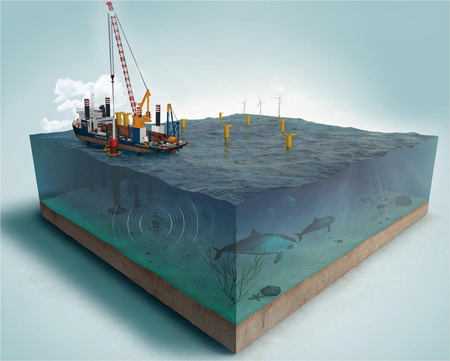
Acoustic mitigation devices are one of industry-standard solutions for preventing adverse effects of marine infrastructural development works, such as physical interaction with construction equipment or exposure to high levels of underwater sound, they are able to temporarily remove wildlife from a project site and potentially harmful activities. However, not all acoustic mitigation devices are the same, FaunaGuard is a set of species-specific devices which are available for marine contractors and other interested parties to hire. These innovative, welfare-first modular devices create a marine mammal exclusion zone by targeting their respective hearing ranges and repelling them with specialised underwater sound patterns.
By Andrew Gillespie, Marine Protection Products Manager, Ace Aquatec, UK
Ace Aquatec is a technology company, headquartered in Dundee, Scotland, which has built its reputation on developing innovative products that drive more welfare-focused practices in aquaculture and the offshore marine sector. Ace Aquatec has grown from a family-run business of two to a global company of 30 with offices and distribution partners in Norway, Canada, Australia, Greece and Chile.
In 2019 the company raised a Series A investment with Netherlands-based investor Aqua Spark, who are committed to transforming the global aquaculture industry into one that is healthier, more sustainable, and more accessible, which became its first investor. Chroma Ventures, the investment arm of 4J Studios run by Scotland’s successful entrepreneurs Paddy Burns and Chris van der Kuyl, quickly followed in 2020. The company is in the process of finalising a game-changing Series B investment round and is on the verge of unveiling new investment partners.
 From Aquaculture to Renewables
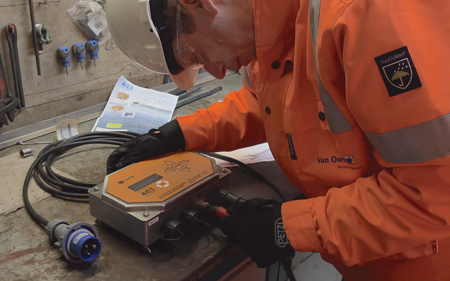
Andrew Gillespie, Marine Protection Products Manager for Ace Aquatec, explains that ‘in the 1990s, our founder John Ace Hopkins was working for technology company Ferranti-Thomson on first generation acoustic devices to protect fish in pens from predatory seals. When the company decided to divest some of its non-core business, John acquired the relevant licences and established Ace Aquatec and has since gone onto provide groundbreaking innovative technology for a growing aquaculture industry in Scotland.’ Noticing the success that these devices had on fish farms by keeping seals away from salmon stocks, Ace Aquatec was approached to develop similar solutions for energy projects to prevent wildlife from entering dangerous zones. This was managed through the launch of the Marine Mammal Mitigation Device for overlapping pinniped and cetacean exclusion, which has been deployed globally.
Environmental Safeguarding and Protection
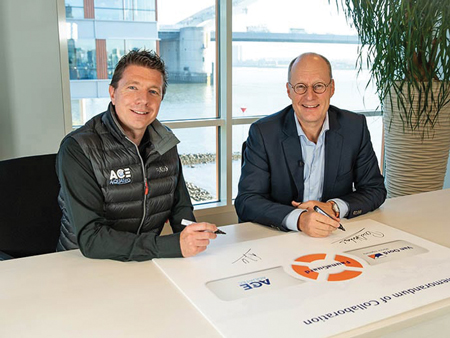
With a very similar timeline, Van Oord in the Netherlands had been using prototypes of FaunaGuard on different projects around the world as a solution for meeting environmental regulations in dredging and later in offshore wind operations. In 2018, a strategic partnership between Ace Aquatec and Van Oord brought together the expertise of two innovative leaders in their respective fields. By introducing academically-validated sound patterns at specific frequencies, devised by noted experts in Europe, with award-winning UK transducer technology, the new FaunaGuard system ensured better environmental safeguarding and protection from loud sound-producing activity than its competitors.
With a very similar timeline, Van Oord in the Netherlands had been using prototypes of FaunaGuard on different projects around the world as a solution for meeting environmental regulations in dredging and later in offshore wind operations. In 2018, a strategic partnership between Ace Aquatec and Van Oord brought together the expertise of two innovative leaders in their respective fields. By introducing academically-validated sound patterns at specific frequencies, devised by noted experts in Europe, with award-winning UK transducer technology, the new FaunaGuard system ensured better environmental safeguarding and protection from loud sound-producing activity than its competitors.
Installation and Deployment Offshore
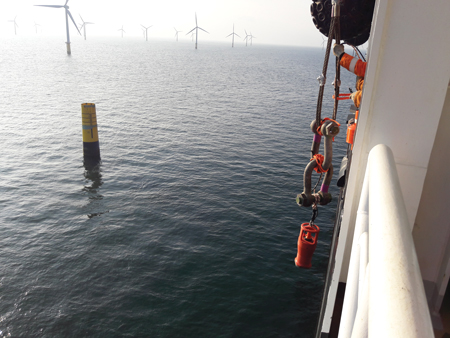
Andrew Gillespie remarks that ‘FaunaGuard is a plug-and-play solution that is very easy to set up and to use. It is typically deployed from the side of an installation vessel prior to the soft start of piledriving operations for the installation of subsea foundations and remains on throughout giving marine animals have ample time to move away. After the piledriving operations cease, FaunaGuard is deactivated and retrieved from the water and stored until the next deployment. The varying sounds emitted by the FaunaGuard module will remain novel and therefore animals are less likely to become accustomed to the noise output.
Andrew Gillespie remarks that ‘FaunaGuard is a plug-and-play solution that is very easy to set up and to use. It is typically deployed from the side of an installation vessel prior to the soft start of piledriving operations for the installation of subsea foundations and remains on throughout giving marine animals have ample time to move away. After the piledriving operations cease, FaunaGuard is deactivated and retrieved from the water and stored until the next deployment. The varying sounds emitted by the FaunaGuard module will remain novel and therefore animals are less likely to become accustomed to the noise output.
 Issues with the Traditional Approach
Traditional mitigating measures often involved pausing activities, once animals had been observed either visually or passive acoustically in the vicinity of construction works, or physical mitigation measures such as turtle deflectors and active relocation. These methods, although successfully used in practice, are somewhat limited. Visual observations are less effective when marine mammals are below surface water or when visibility is low, for example during bad weather or at night-time. Methods that rely on physical contact may cause undue stress and harm to marine fauna and, therefore, are often not permitted by the relevant authoritative bodies. As such, the need for a technology-based, non-contact solution is the only way to avoid work delays without causing stress to nearby wildlife.
Quality of Safe Sound
Many traditional acoustic deterrent devices (ADDs) on the market tend to apply a single pure tone on repeat and at a fixed loud volume, which can lead to deafness and habituation. The FaunaGuard philosophy differs in that a series of complex tonal patterns are applied, at the lowest possible levels of sound, in order to reduce the risk of a permanent or temporary shift in the auditory threshold. Playing these tones at a set of defined frequency spectra elicits a behavioural response from a particular species or species group. The tones include sweeps and impulsive sounds with random inter-pulse intervals to reduce the possibility of habituation by remaining novel. Regulatory bodies now openly state that sound levels emitted by some traditional ADDs are dangerous and detrimental to marine fauna; therefore, they would prefer to see safer, more welfare-focused devices like FaunaGuard being deployed as standard in offshore wind projects.
Many traditional acoustic deterrent devices (ADDs) on the market tend to apply a single pure tone on repeat and at a fixed loud volume, which can lead to deafness and habituation. The FaunaGuard philosophy differs in that a series of complex tonal patterns are applied, at the lowest possible levels of sound, in order to reduce the risk of a permanent or temporary shift in the auditory threshold. Playing these tones at a set of defined frequency spectra elicits a behavioural response from a particular species or species group. The tones include sweeps and impulsive sounds with random inter-pulse intervals to reduce the possibility of habituation by remaining novel. Regulatory bodies now openly state that sound levels emitted by some traditional ADDs are dangerous and detrimental to marine fauna; therefore, they would prefer to see safer, more welfare-focused devices like FaunaGuard being deployed as standard in offshore wind projects.
A Species-Specific Approach
The aim of FaunaGuard has always been to condition avoidance through optimal use of the functional hearing capabilities of a target species and to focus sounds using modern acoustic techniques to make construction zones temporarily unattractive to inhabit. The modular approach to offshore marine life protection means applying several tried-and-tested sounds through different transducers, which is conducive to a species-specific solution. The duration of sounds and the frequency bands take those directional hearing abilities of marine fauna into consideration. Moreover, the FaunaGuard Fish, Seal and Turtle modules avoid sound emissions in unnecessary frequency ranges by filtering out high-frequency harmonics.
The aim of FaunaGuard has always been to condition avoidance through optimal use of the functional hearing capabilities of a target species and to focus sounds using modern acoustic techniques to make construction zones temporarily unattractive to inhabit. The modular approach to offshore marine life protection means applying several tried-and-tested sounds through different transducers, which is conducive to a species-specific solution. The duration of sounds and the frequency bands take those directional hearing abilities of marine fauna into consideration. Moreover, the FaunaGuard Fish, Seal and Turtle modules avoid sound emissions in unnecessary frequency ranges by filtering out high-frequency harmonics.
 Adding Scientific Validation
In order to guarantee high performance levels, FaunaGuard continues to collaborate with several marine research institutes and universities worldwide. Independent experts in marine biology and underwater acoustics are approached not only to determine suitable sound patterns from researching the literature on previous studies but also to assess their effectiveness on different marine mammals. Any FaunaGuard module must follow the complete path from literature study and theoretical sound development, then laboratory basin tests to determine behavioural response levels and, finally, field tests with wild animals in their natural open-water environment to demonstrate success rate.
Gaining Regulatory Approval
There are currently four FaunaGuard modules that are commercially available. The FaunaGuard Porpoise module was the first to market has been the most popular hire, given the prevalence of harbour porpoises in the North Sea and other European bodies of water. The robust, offshore-ready hardware for the FaunaGuard Porpoise module was recognised by the Federal Maritime and Hydrographic Agency in Germany, which approved installation and deployment in the German exclusive economic zone.
There are currently four FaunaGuard modules that are commercially available. The FaunaGuard Porpoise module was the first to market has been the most popular hire, given the prevalence of harbour porpoises in the North Sea and other European bodies of water. The robust, offshore-ready hardware for the FaunaGuard Porpoise module was recognised by the Federal Maritime and Hydrographic Agency in Germany, which approved installation and deployment in the German exclusive economic zone.
Independent Endorsement
Reputable environmental experts have studied the response of harbour porpoises to FaunaGuard and piling sounds during construction of several offshore wind farms in the North Sea. The findings, which have been presented at a series of academic events in 2022, demonstrated that FaunaGuard is a highly effective device with a 48% decrease in porpoise detection rates up to distances of 1.5 kilometres, compared with the traditional acoustic mitigation devices at 36%. After the first 30 minutes of FaunaGuard operation, porpoise detection rates declined to almost zero within a 1.25-kilometre radius. It was also concluded that neither a long-term deterrent effect nor a habituation effect seems likely, as FaunaGuard uses separate and complex signal sequences, and that the protection impact observed in the North Sea is readily transferable to the Baltic Sea and other bodies of water.
Reputable environmental experts have studied the response of harbour porpoises to FaunaGuard and piling sounds during construction of several offshore wind farms in the North Sea. The findings, which have been presented at a series of academic events in 2022, demonstrated that FaunaGuard is a highly effective device with a 48% decrease in porpoise detection rates up to distances of 1.5 kilometres, compared with the traditional acoustic mitigation devices at 36%. After the first 30 minutes of FaunaGuard operation, porpoise detection rates declined to almost zero within a 1.25-kilometre radius. It was also concluded that neither a long-term deterrent effect nor a habituation effect seems likely, as FaunaGuard uses separate and complex signal sequences, and that the protection impact observed in the North Sea is readily transferable to the Baltic Sea and other bodies of water.
 Recent European Projects
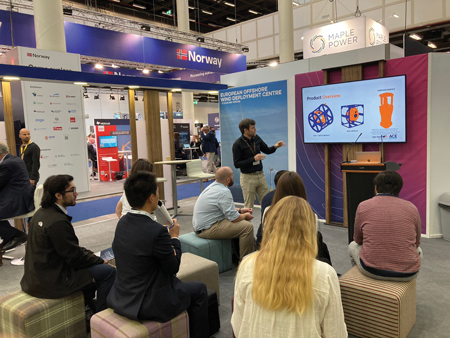
Having been successfully implemented on offshore wind projects in Germany, use of FaunaGuard has gradually spread across Europe. It was specifically requested for the first ever wind farm installation in Italy and, at the time of writing, multiple FaunaGuard modules are being delivered to one of the major EPCI contractors as a component of the development of a substantial wind farm project in the Netherlands. Ultimately, FaunaGuard is seen an important step towards a less harmful piling procedure around the world.
The Future of FaunaGuard
As the global demand for clean renewable and sustainable energy is expected to increase and greener alternatives for energy production are sought, so increases the need to protect marine mammals from injury or negative disturbance in these projects. The FaunaGuard team feel confident that their welfare-first systems will help increase industry and regulator confidence and ultimately protect a variety of targeted marine mammals around offshore construction sites.
As the global demand for clean renewable and sustainable energy is expected to increase and greener alternatives for energy production are sought, so increases the need to protect marine mammals from injury or negative disturbance in these projects. The FaunaGuard team feel confident that their welfare-first systems will help increase industry and regulator confidence and ultimately protect a variety of targeted marine mammals around offshore construction sites.
Biography of the Author
As Marine Protection Products Manager, Andrew Gillespie is responsible for all commercial operations, from winning business to fulfilling customer project requirements and defining development strategy. Prior to joining Ace Aquatec, he held roles in the health-care sector, sports coaching and development, and education, promoting English as a Foreign Language. Andrew has been with the company since 2018.
As Marine Protection Products Manager, Andrew Gillespie is responsible for all commercial operations, from winning business to fulfilling customer project requirements and defining development strategy. Prior to joining Ace Aquatec, he held roles in the health-care sector, sports coaching and development, and education, promoting English as a Foreign Language. Andrew has been with the company since 2018.